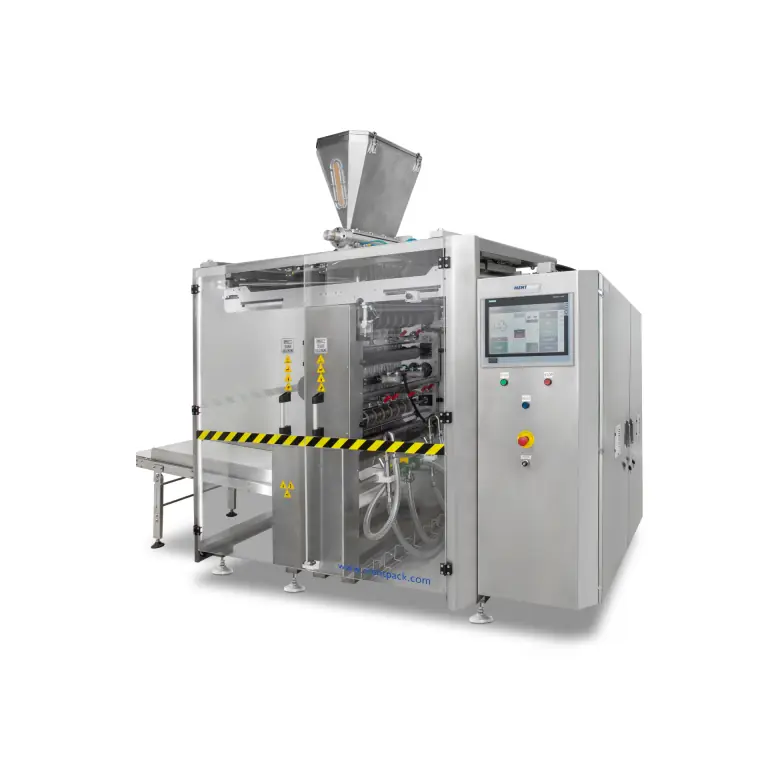
Dry Yeast
Comprehensive packaging solutions engineered for free-flowing granular products. Whether you are packaging sugar, salt, black pepper, instant coffee, or dry yeast, our volumetric cup dosing systems provide exact weight accuracy with minimal product waste. Built for continuous high-speed operation, these lines ensure seamless transitions and maximized throughput for single-serve sticks and sachets.
Packaging Notes
Dry yeast is alive: heat, moisture and oxygen all cost viability, and dosing must be gentle as well as precise. A dry yeast packaging machine is therefore part of the shelf life, not a step that follows it. Friction and long fall paths warm the granules, mechanical shear damages cells, the hygroscopic granule takes up ambient humidity wherever it sits open, and oxygen left in the headspace keeps working against the culture until the pack is opened. Controlled-temperature filling paths, high-barrier films and optional nitrogen flush keep fermentation power to the printed date. The pack is small as well — one bake is 10 to 15 g — so a few tenths of a gram of drift is a real share of the dose, and an under-filled sachet reaches the consumer as dough that does not rise. Dry yeast belongs to the free flowing granules group, and that is what makes precise dosing possible at speed: it discharges cleanly, does not bridge in the hopper and repeatably fills a defined volume. Volumetric cup dosing is the natural first choice — nothing rotates through the product, shear stays low, and the drop into the pack is short. Auger dosing is the alternative where the granulation is finer or the dose window is narrow, since a servo-driven auger meters by revolution rather than by volume and can be trimmed as bulk density drifts between batches. Either way, the dry yeast filling machine keeps the product path enclosed and temperature-controlled. The single-bake sachet is the global standard for home baking, and most projects start there: a 3-side or 4-side seal sachet holding one bake, sold in strips of three or four with the proving instructions printed on it. A dry yeast stick pack machine puts the same dose in a narrower, longer pack that tears open with one hand and pours straight into a bowl, and that bundles neatly into an outer bag or carton. Larger, non-domestic quantities move into pillow bags on VFFS lines, where the dose is a bakery portion rather than a household one. Sealing matters as much as dosing, because a weak seal undoes both the barrier film and the nitrogen flush. Doses in this group run from 10 to 15 g. Output is multi-lane, so the machine's cycle rate and the packs produced per minute are not the same number — the lane count follows the pack width. The CSM1200 works with 6 to 12 lanes: on a narrow pack at the 12-lane end it produces up to 960 packs per minute, while the same machine on a wide pack runs 6 lanes and produces up to 480 packs per minute. The CSM600 works with 3 to 7 lanes and scales the same way. Two machines cover the product as a dry yeast sachet packaging machine or as a stick pack line: the CSM1200 with 6 to 12 lanes where output is the constraint, and the CSM600 with 3 to 7 lanes for smaller lines and narrower format ranges. Typical buyers are yeast producers and baking-ingredient companies, private-label co-packers supplying retail home-baking brands, and food groups that pack a yeast sachet alongside a flour or bread-mix product. The same equipment handles comparable free flowing granules in single-dose sachets, where the change is in the dosing set-up rather than in the machine concept.