Coffee Powder
Advanced packaging technology designed specifically for non-free-flowing powders. Utilizing state-of-the-art servo-driven auger fillers, our machines deliver exceptional dosing accuracy for challenging products like powder coffee, milk powder, protein powder, baking powder, macrogol, and chemicals. Engineered with anti-dust architectures and independent agitation systems to prevent bridging and ensure perfect seal integrity.
Packaging Notes
Ground coffee releases CO₂ after roasting and loses aroma to oxygen — the pack must breathe out without letting air in. That single conflict shapes the whole line: high-barrier films protect flavour, a one-way degassing valve lets CO₂ escape where the format allows it, and an optional nitrogen flush displaces the air in the headspace before sealing to extend freshness. The powder itself is non-free-flowing. It bridges in the hopper, compacts under its own weight and changes bulk density with grind and roast level, so a setting that was correct at the start of a shift can drift hours later. Fine particles also travel: dust that settles on the sealing area is the usual cause of leaking packs. For that reason a coffee powder filling machine is built around auger dosing. Auger dosing controls fine-grind dust because the product stays confined in the tube and is metered by a counted number of screw turns instead of falling freely through open air. An agitator keeps the hopper live above the screw so the column does not arch, and weight feedback trims the turn count when density changes between batches. Volumetric cups and gravity fillers are quicker to clean but do not hold dose accuracy on a compressible, dusty powder like ground coffee. Three pack formats cover most of the demand. A coffee stick pack machine produces the narrow single-dose stick used for hotel rooms, office coffee service, sampling and travel packs: one cup, no scoop, little air inside. A coffee sachet packaging machine makes the wider three- or four-side seal sachet used for filter and pour-over portions and for retail multipacks, where the flatter shape carries more print. At the top of the dose range, larger pillow bags and stand-up formats serve retail shelves and catering kitchens, where the pack is opened repeatedly and barrier matters more than portioning. Single-serve sticks and sachets are among the fastest-growing coffee formats worldwide. Dose range is 10–1000 g. Output depends on pack width, because these are multi-lane machines: the same frame runs more lanes on a narrow pack and fewer on a wide one. An SPM1200 reaches up to 840 packs per minute with 12 lanes on a narrow stick, and up to 490 packs per minute with 7 lanes on a wider pack. Lane counts by model: ARTISTICK 1–5, HSM 1–3, ISM400 2–5, SPM320 1–8, SPM800 4–12, SPM1200 7–12. Coffee packaging machine options from Mentpack for this product are ARTISTICK, HSM, ISM400, SPM320, SPM800, SPM1200, VB, VB-MINI and VB-PLUS. Typical buyers are roasters packing their own retail and HORECA lines, private-label co-packers, instant and blended beverage producers, and exporters supplying hotel and office coffee programmes.
Compatible Machines
Sachet Machines

ISM400
Entry Level Intermittent Sachet Machine
// The Mentpack ISM400 represents the intelligent entry point into p...
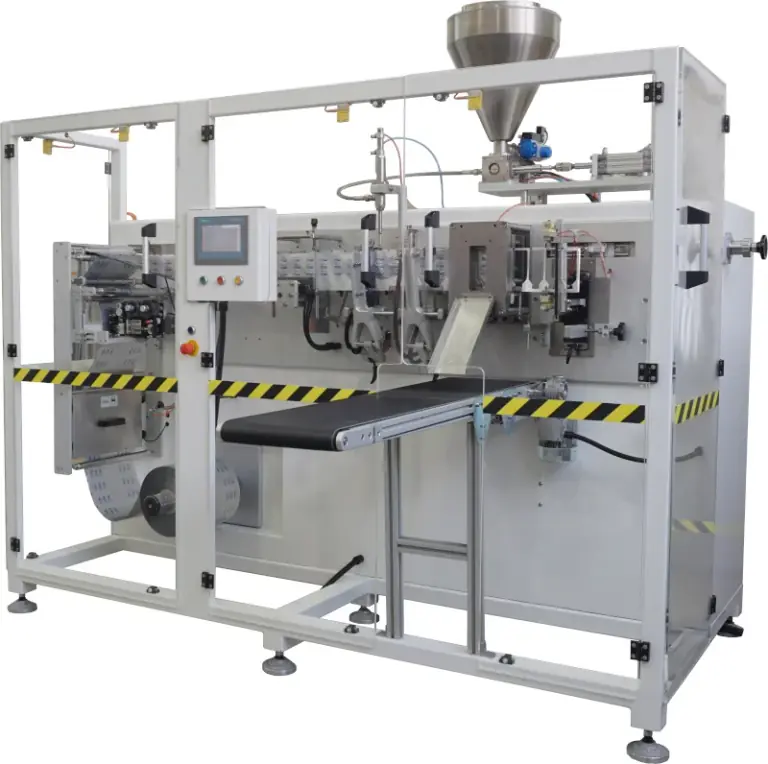
HSM
Horizontal Sachet Machine
// The Mentpack HSM Horizontal Sachet Packaging Machine is meticulou...
Stick Pack Machines

SPM1200
SPM1200 Stick Pack Machine
// SPM1200: The Apex of Stick Pack Production Unleash unparalleled ...

SPM800
SPM800 Stick Pack Machine
// ## Mentpack SPM800 Stick Pack Machine: Unleash Unparalleled Mass ...

SPM320
SPM320 Stick Pack Machine
// Introducing the **Mentpack SPM320: Maximize Your Productivity, Mi...

ARTISTICK
Artistick Stick Pack Machine
// Introducing the Artistick, Mentpack's foundational solution for p...
Vertical Form, Fill & Seal

VB-PLUS
Performance Vertical Form, Fill & Seal Machine
// Elevate your capabilities with the Performance Vertical Form, Fil...

VB
Vertical Form, Fill & Seal Machine
// Elevate your capabilities with the Vertical Form, Fill & Seal Mac...
-medium.webp?dpl=dpl_BF6GvyQD69GzBR4NqJ5xC4VX1LPT)
VB-MINI
Mini Vertical Form, Fill & Seal Machine
// Elevate your capabilities with the Mini Vertical Form, Fill & Sea...