Vanilla Powder
Advanced packaging technology designed specifically for non-free-flowing powders. Utilizing state-of-the-art servo-driven auger fillers, our machines deliver exceptional dosing accuracy for challenging products like powder coffee, milk powder, protein powder, baking powder, macrogol, and chemicals. Engineered with anti-dust architectures and independent agitation systems to prevent bridging and ensure perfect seal integrity.
Packaging Notes
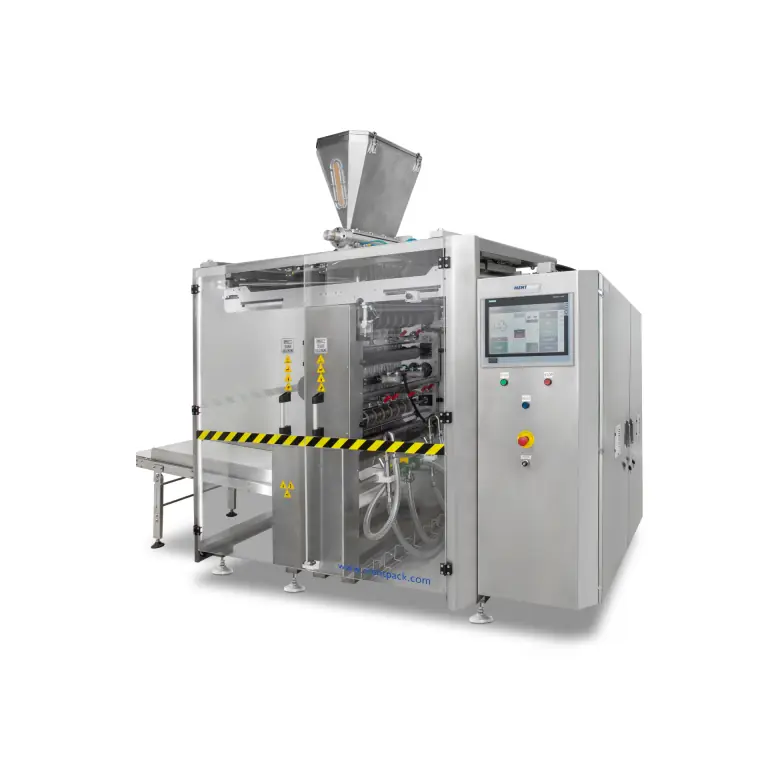
Vanilla powder carries one of the most valuable aromas in food on a fine sugar or starch base. That combination is what makes it awkward to pack. The aroma sits on the carrier rather than inside it, so anything that heats, vents or agitates the product too aggressively costs flavour before the pack is even sealed. The powder itself is non-free flowing: it bridges in the hopper, clings to contact surfaces and does not settle at a repeatable density on its own. It is also light and it dusts, and vanilla dust does not stay where it is put — it travels through a filling room and turns up in neighbouring production. Aroma-barrier films and gentle, dust-controlled dosing are therefore not refinements on a vanilla powder packaging machine; they are the specification. Auger dosing is the method that fits. An auger meters by turns rather than by free fall, so it can move a bridging, cohesive powder at a controlled rate and place it into the pack without throwing a cloud. Volumetric cups assume a powder that flows and settles consistently, which non-free-flowing vanilla does not do; piston filling belongs to liquids and pastes. On a vanilla powder filling machine the auger is normally paired with an agitator that keeps the hopper live without whipping air into the product, with dust extraction, and with a seal jaw area kept clean — a dusted seal is where leaks and aroma loss begin. The formats follow the dose. The small baking sachet — a recipe's exact dose, opened once and used at once — is the traditional vanilla format and still the largest; a vanilla powder sachet packaging machine forms, fills and seals it in several lanes from reel. Stick pack carries the same single-dose logic in a slimmer body, and a vanilla powder stick pack machine reaches higher lane counts in the same footprint, which suits retail multipacks and baking kits. Larger portions for craft bakeries and industrial kitchens run as VFFS pillow bags, where the same auger set feeds a vertical bagger instead of a multi-lane block. Typical fill weights are 5 to 15 g. Output depends on pack width, because width sets the lane count, and the lane count — not the cycle rate — sets packs per minute. A CSM1200 runs 6 to 12 lanes: narrow single-dose packs reach up to 960 packs per minute, while wide packs on the same machine run 6 lanes and up to 480 packs per minute. A CSM600 runs 3 to 7 lanes for smaller lines, frequent changeovers or a second shift. Mentpack builds both machines for this product: the CSM1200 for high-volume sachet and stick pack lines, the CSM600 for narrower ranges or a second product family. Buyers are flavour and baking-ingredient houses, spice and dessert-mix producers, and private-label co-packers supplying retail baking aisles.